
Mud daubers are solitary wasps that build small tube-shaped mud nests on walls, eaves, and in sheds. Non-aggressive and rarely stinging, they are mostly a cosmetic nuisance around Whidbey and Fidalgo structures.
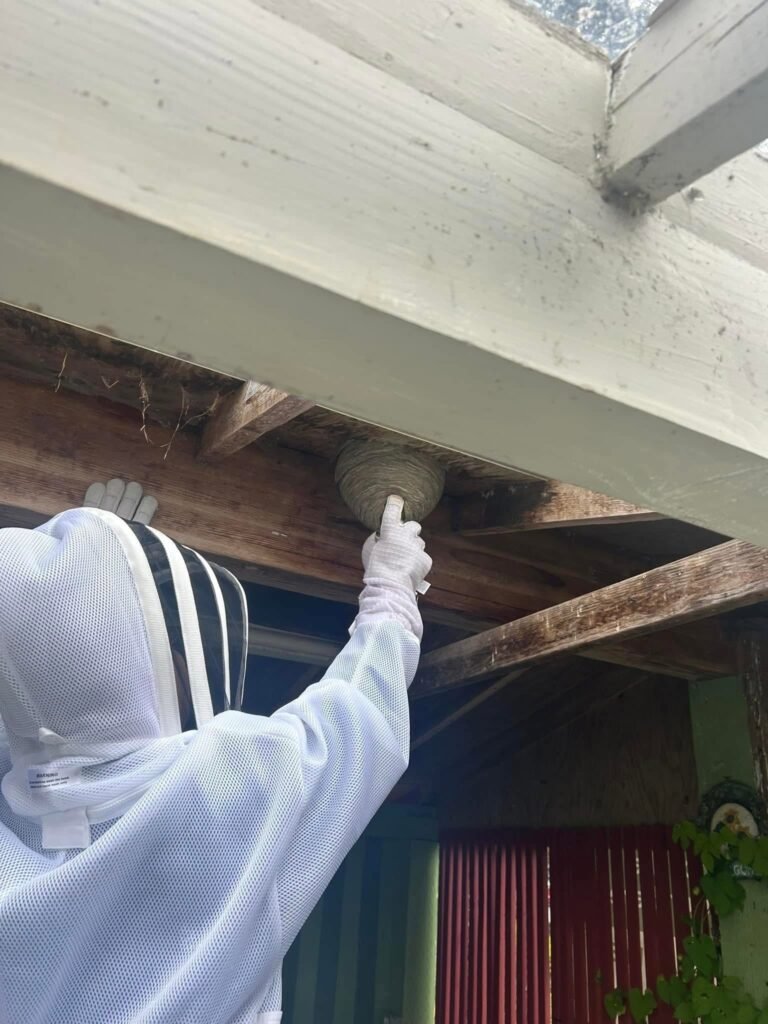
How to identify mud daubers
Slender, 1/2 to 1 inch, often black or metallic blue with a thread-like waist. Their nests are distinctive mud tubes or clusters plastered on sheltered surfaces.
Behavior & season on Whidbey & Fidalgo
Each female works alone, provisioning mud cells with spiders for her larvae. They are active in warm months and favor sheltered walls, eaves, sheds, and under decks.
Why mud daubers are a problem
They are docile and seldom sting, so the main issue is unsightly mud nests and staining. Abandoned nests can, however, be reused by other, more aggressive wasps.
Signs of mud daubers activity
- Tube- or organ-pipe-shaped mud nests on walls and eaves
- Solitary wasps carrying mud or spiders
- Nests in sheds, garages, and under decks
- Little defensive behavior
How Salty Dog treats mud daubers
We remove nests and clean the surfaces, and treat sheltered areas where they repeatedly build so nests do not accumulate. Learn more about our Wasp & Hornet Control service, or browse the full Pest Library.
Reviewed by Matthew — Salty Dog Pest Control. WSDA-licensed structural pest applicator (License #101709). Veteran- and family-owned, serving Whidbey Island, Fidalgo Island, and west Skagit County.
Frequently asked questions
Are mud daubers dangerous?
No — they are solitary and rarely sting. The concern is mostly cosmetic, plus old nests being reused by other wasps.
What are the mud tubes on my siding?
Those are mud dauber nests, each cell stocked with spiders for the larvae. They are easily removed and cleaned.
Had a good experience with Salty Dog? Leave us a review — it helps your Whidbey and Fidalgo neighbors find honest, local pest control.