
Roof rats are agile climbing rats that nest high — in attics, wall voids, and dense vegetation. Slender and dark, they travel utility lines and overhanging branches into Whidbey homes, gnawing wiring and contaminating attic insulation.
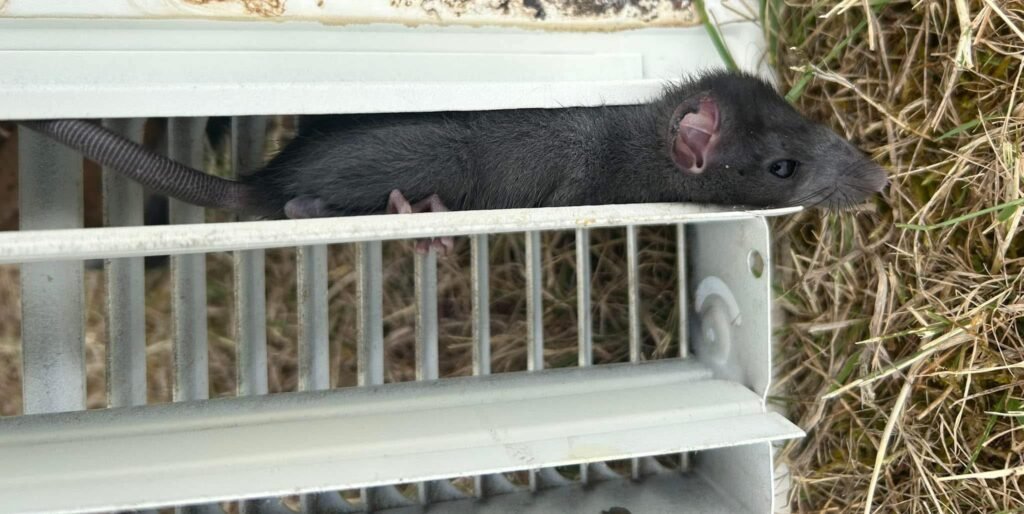
How to identify roof rats
Slender, 6 to 8 inches with a tail longer than the body, dark gray to black fur, large ears, and a pointed nose. Droppings are smaller and pointed at the ends.
Behavior & season on Whidbey & Fidalgo
Excellent climbers, they prefer upper levels and enter along branches, wires, and rooflines. They are active year-round here and shelter in attics, soffits, and dense landscaping.
Why roof rats are a problem
Gnawed wiring in attics is a fire hazard, and their droppings and urine contaminate insulation and stored items. They reproduce rapidly and are hard to exclude without sealing elevated entry points.
Signs of roof rats activity
- Pointed droppings in the attic or on rafters
- Noises overhead at night
- Gnaw marks on wiring and roofline wood
- Runways through insulation
- Branches or wires contacting the roof
How Salty Dog treats roof rats
We identify elevated entry points, remove the rodents, seal roofline and soffit gaps, trim access routes, and restore fouled insulation where needed. Learn more about our Rodent Control service, or browse the full Pest Library.
Reviewed by Matthew — Salty Dog Pest Control. WSDA-licensed structural pest applicator (License #101709). Veteran- and family-owned, serving Whidbey Island, Fidalgo Island, and west Skagit County.
Frequently asked questions
How do roof rats get into the attic?
They climb — overhanging branches, utility lines, and gaps at the roofline and soffits. Cutting access and sealing gaps is essential.
Is the scratching at night rats or mice?
Persistent overhead noise usually points to roof rats; an inspection confirms the species and entry points.
Had a good experience with Salty Dog? Leave us a review — it helps your Whidbey and Fidalgo neighbors find honest, local pest control.